Teaching English learners language of math
 EdSource Today/Laurie Udesky
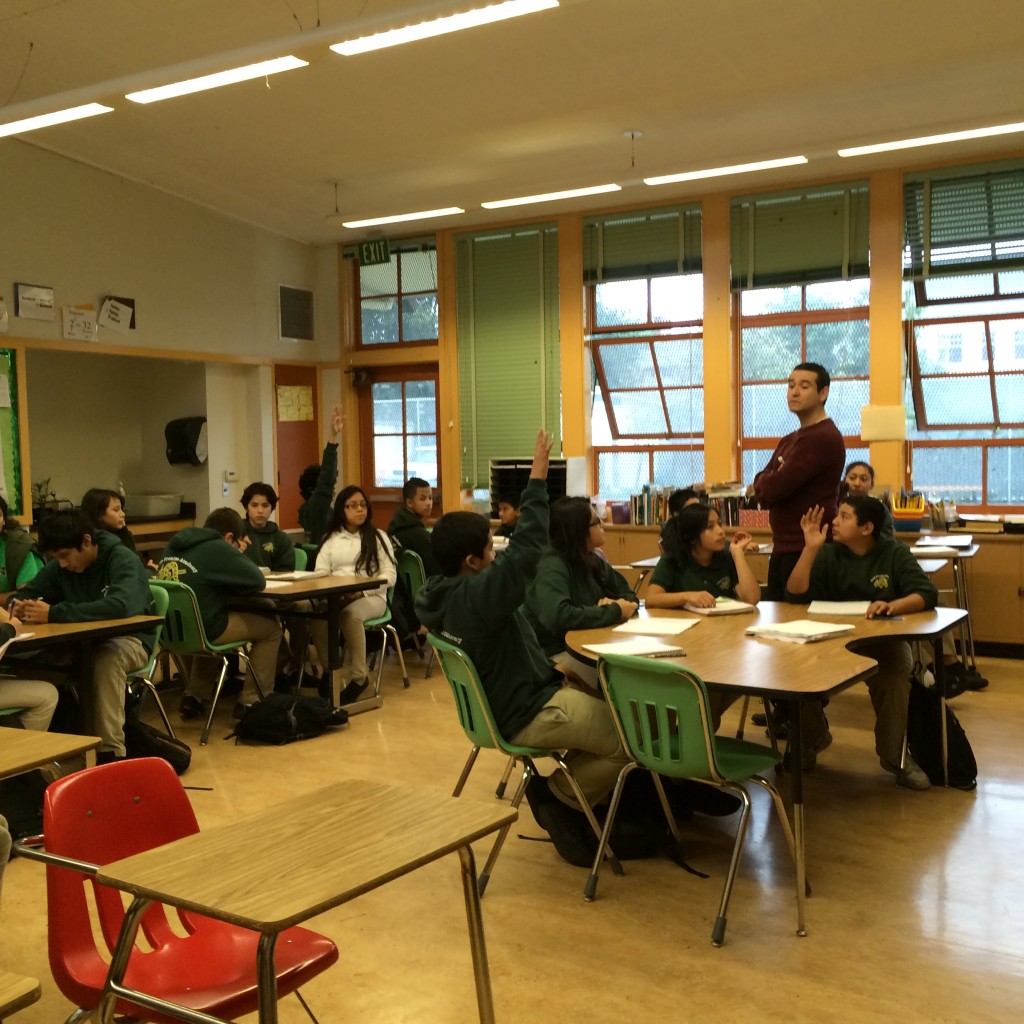
David Ramirez teaches math to pocket-size groups of 7th-course students in his classroom at the Urban Promise Academy in Oakland.
As instructor David Ramirez strode around his 7th-grade classroom at Oakland's Urban Promise Academy, he was taking on a central challenge of the new Common Core standards: how to ensure that students who lack proficiency in English are able to benefit from a more than language-based approach to learning complex math concepts.
Virtually of the students in Ramirez's class in this small Oakland public schoolhouse are classified as English learners and most live in immigrant households. Their command of English ranges from minimal, to agreement parts of lessons, to speaking hesitantly. In most all cases, their native language is Spanish, although the class likewise includes students whose offset language is English. With 23 pct of California's six.ii 1000000 students classified equally English learners, Ramirez'south challenge is one that faces thousands of other teachers across the country.

EdSource Today/Laurie Udesky
Seventh-course math students at Oakland'due south Urban Promise Academy work on solving a math problem.
Under the Common Core Land Standards adopted past California, 42 other states and the Commune of Columbia, math teachers whose students accept varying levels of English comprehension are using innovative ways to teach them math, including the vocabulary of math and ways for the students to hash out how they came up with their answers.
The issue of making certain English learners benefit from the Mutual Cadre has been the subject area of considerable enquiry and discussion. One fundamental finding is that much of what students learn tin come up from their interactions with fellow students in small group discussions where they analyze a problem, critique each other'south reasoning and detect the all-time way to talk about information technology. That practice is on full display in Ramirez'due south course, where students work in small groups much of the fourth dimension.
In the past, Ramirez said, students may non have known how they reached an reply to a math problem. "With the Common Cadre," he said, "teachers are pushed to a new level in order to have students clearly understand what they are doing and why their answer makes sense."
To bridge the linguistic communication gulf betwixt the math terms he must use in his class and the express English proficiency of some of his students, Ramirez spends the first 30 minutes of each class just on math vocabulary.
His lesson on a recent forenoon focused on "proportional relationships" between quantities, a key part of the 7th-form Mutual Core standards.
Ramirez focused on the relationship between two squares of unlike sizes that he had fatigued on the board. He threw out concepts using words like "enlarge," "reduce" and "calibration," then illustrated each of them and challenged students to interpret the words' meanings in groups as he listened to their discussions.
Teachers apply other strategies to assistance English learners sympathize terminology that may be out of their attain. For case, in a math problem that is written in a narrative grade, teachers may tell English learners to circumvolve words that are repeated frequently in the problem, said Crystal Hoffmann, a project specialist with the Kern Unified Loftier School Commune who trains teachers to work effectively with English learners.
In groups, Hoffmann said, students focus on the importance of the circled words, talk nearly them and effigy out their meaning. Those small group discussions – a major element of the Mutual Core'southward commitment to collaborative learning – are cardinal to helping button students.
Students who are newer to the English linguistic communication are not e'er able to verbalize the reasoning behind their answers, said Jeffrey Grisham, a fifth-form math teacher at Kennedy Uncomplicated School in Santa Ana.
Small group discussions permit English learners to "express themselves freely," said Martin Perez, a 4th-grade math instructor at Kennedy Elementary in Santa Ana. "It'south not just well-nigh math. It's well-nigh kids that are so intimidated to say anything."
Grisham makes certain that groups include a mix of students – English learners who sit alongside native and fluent English speakers and those who excel in math.
"The English language learners have learned how to express ideas by listening to the chat of the other students," Grisham said.
Martin Perez, a 4th-grade teacher at Kennedy Elementary, agreed, saying that the small groups may be the simply way that a student struggling with English feels comfortable to speak upward.
"It allows them to limited themselves freely," Perez said. "Information technology's non just virtually math. It'south nearly kids that are and then intimidated to say anything,"
Perez recalled one student in a small grouping who talked about math concepts using a combination of English and Spanish. Perez, who understands Spanish, can mind and estimate whether her reasoning is faulty or on rail.
"She struggles, but when I hear her explaining something, it shows she'southward going through the cognitive steps to go through to the answer," Perez said. Her exam scores likewise bear witness him that she'southward picking up the math concepts he overhears her enunciate.
More-proficient English language speakers may help those with less English language understand math concepts. Simply Hoffmann, who coaches loftier school teachers working with English language learners, said learning the language of math or any other subject is a challenge for many students – not only those who are learning English.
Many high school students struggle with bookish language, Hoffmann said. Considering of that, she added, "We try to teach teachers to eternalize linguistic communication beyond the board."
The Common Core standards require that math teachers spend substantially more than time helping students than in the past, Perez said.
"It's a huge paradigm shift in the way math has been taught in this land," Perez added, "and information technology's then much better, because information technology requires a really active mind at piece of work, not merely ane following rote steps. Basically, information technology boils down to students teaching students."
"The English language learners accept learned how to express ideas by listening to the conversation of the other students," said Jeffrey Grisham, a 5th-grade math teacher at Kennedy Elementary in Santa Ana.
Ramirez, the Urban Promise Academy instructor, said the new standards allow him to use math problems to the realities of everyday life experienced by his students – something he yearned for when he studied math in school.
For example, in a lesson on how to calculate the rate at which something occurs, he asked his students to look at schoolhouse dropout rates by race, which hitting abode for several of them. Others mentioned that members of their families exercise not have high school diplomas.
"I always wanted math to tie into my everyday life," Ramirez said. Now, he said, he is giving his students reasons "for why we need to know math."
Post-obit is theproportional relationships standard,one of the Mutual Cadre standards for 7th-grade math:
- Analyze proportional relationships and use them to solve real-world and mathematical problems.
- Compute unit rates associated with ratios of fractions, including ratios of lengths, areas and other quantities measured in like or unlike units.For example, if a person walks ane/2 mile in each one/4 hr, compute the unit rate equally the complex fraction 1/2/i/4 miles per hour, equivalently 2 miles per hr.
- Recognize and stand for proportional relationships between quantities.
- Decide whether ii quantities are in a proportional relationship, e.k., by testing for equivalent ratios in a table or graphing on a coordinate aeroplane and observing whether the graph is a straight line through the origin.
- Identify the constant of proportionality (unit of measurement rate) in tables, graphs, equations, diagrams, and verbal descriptions of proportional relationships.
- Represent proportional relationships by equations.For case, if total cost t is proportional to the number north of items purchased at a abiding cost p, the relationship between the total cost and the number of items tin can be expressed equally t = pn.
- Explain what a point (ten,y) on the graph of a proportional relationship means in terms of the situation, with special attending to the points (0, 0) and (i,r) where r is the unit rate.
- Use proportional relationships to solve multistep ratio and per centum issues. Examples: simple interest, tax, markups and markdowns, gratuities and commissions, fees, percent increase and decrease, percent error.
To go more reports like this 1, click here to sign up for EdSource's no-toll daily e-mail on latest developments in education.
Source: https://edsource.org/2014/teaching-english-learners-language-of-math/71305
0 Response to "Teaching English learners language of math"
Post a Comment