Unity Saying I Uploaded Avatar but Not Showing Up on My Avatars
Local folder or tarball paths
Troubleshooting
This department provides information on the following problems:
| Type of error: | Fault message: |
|---|---|
| General startup issues | - Error messages in the Packet Managing director window - Package Manager missing or window doesn't open - Problems afterward upgrading Unity to new version - Resetting your project'southward bundle configuration |
| Package installation problems | - Package installation fails - Packages not recognized |
| Problems installing git dependencies | - No 'git' executable was found - git-lfs: command not plant - Repository not found - Could non read Username: terminal prompts disabled - Can't update Git version |
| Asset Store A growing library of free and commercial avails created by Unity and members of the community. Offers a wide variety of avails, from textures, models and animations to whole projection examples, tutorials and Editor extensions. More info See in Glossary packages (My Assets) | - 'Failed to parse Http response' in My Assets context |
| Scoped registries | - Missing 'My Registries' in the Package Director window |
| Bug when building packages | - Missing MonoBehaviour errors - Loading error for hostfxr.dll on Windows |
Y'all tin can also run the Unity Package Manager Diagnostics tool if you are experiencing problems that might exist network-related. For more data, come across Network problems.
Error messages in the Packet Manager window
The Packet Manager displays mistake indicators in the Package Manager window when it encounters problems:
-
System-wide issues
Error letters that appear in the status bar indicate the Package Manager has detected an issue that is not related to a specific bundle. For example, if the Package Managing director cannot access the package registry server, it displays this message in the status bar:

Network error message If your network cannot attain the package registry server, it is probably because there is a connectedness problem with the network. When you or your system administrator ready the network error, the status bar clears.
If your network connectedness is working, but you are not signed into your Unity account, the Package Manager doesn't display any Asset Shop packages. When you try to use the My Assets context, the Package Director displays an error in the condition bar:

Logged out of Unity business relationship Click the Sign in push inside the listing view to sign into your Unity account through the Unity Hub.
-
Package-specific problems
If a specific package has a problem when loading or installing (for example, when determining which bundle versions to load), the error icon (
 ) appears in the bundle list next to the compromised package (A). To find out what the problem is, open up the compromised package'southward details view to see the detailed fault message (B):
Dependency error message
Bundle Manager missing or window doesn't open up
The Package Manager window might get moved offscreen or hidden by some other window. When this happens, it looks like the Bundle Manager window failed to open. In this case, you can endeavor to reset the window layout (Window > Layouts > Default) and reopen the Package Manager window over again.
If the Parcel Manager window all the same doesn't appear, check your Unity Console window A Unity Editor window that shows errors, warnings and other messages generated by Unity, or your own scripts. More info
Run across in Glossary :
Failed to resolve packages: The file [<project-path>/Packages/manifest.json] is not valid JSON: Unexpected token '}' at 44:1 } This error message indicates that your manifest.json file is malformed. It likewise tells you lot the line number where the Bundle Manager failed to parse the file, so you lot can fix the JSON. There are a number of online validators that yous can apply to endeavor to correct the trouble. Once yous salvage the corrected file, Unity reloads the Package Manager window.
If you upgraded from an early version of the Unity Editor, there may be other issues with your parcel manifest Each package has a manifest, which provides information about the package to the Bundle Manager. The manifest contains data such as the proper noun of the package, its version, a description for users, dependencies on other packages (if any), and other details. More info
See in Glossary file:
-
Every bit of 2019.three, your
manifest.jsonfile should not contain any references to the com.unity.package-managing director-ui packet. You can either reset your projection'due south bundle configuration or remove the following line from the manifest'southward dependencies listing:"com.unity.package-manager-ui": "2.one.1", -
Check to see if your project manifest Each Unity project has a project manifest, which acts as an entry point for the Package Manager. This file must be bachelor in the
<projection>/Packagesdirectory. The Package Director uses it to configure many things, including a listing of dependencies for that project, as well every bit any bundle repository to query for packages. More info
See in Glossary uses "exclude" as a package version. This is an obsolete value for the dependencies
Come across in Glossary belongings. If you find whatever lines like these, remove the entire line. Parcel Manager but installs packages that are explicitly included every bit a dependency in your project, then once you remove that entry, Bundle Managing director ignores the bundle and doesn't install it.
If the Bundle Managing director still fails to load, follow the procedures under Packages not recognized and Resetting your project's package configuration.
Problems afterward upgrading Unity to new version
When yous upgrade a projection to a newer Unity version, the Package Manager automatically updates incompatible packages to newer uniform versions. Yet, if your package doesn't compile, the Package Manager displays mistake messages in the Panel.
To correct these messages, read the error messages and prepare any problems you can. For case, a package might be missing a dependency on another packet or version. In that example, you tin effort and install the parcel yourself.
You tin likewise effort the following sequence of solutions until you find something that works:
- Dorsum up and then delete the
Packagesfolder under your project. - Back upwardly and then delete the package sources in your projection's
Packagesfolder, leaving only themanifest.jsonfile. Then attempt to reload the project. - Create a new empty project. If the Bundle Manager window loads successfully, supplant the
Library/PackageCache/com.unity.package-manager-ui@<version>folder in the failing project with the same folder from the newly created projection. - As a terminal resort, yous can reset your project to the default package Unity automatically pre-installs a select number of default packages (for case, the Analytics Library, Unity Timeline, etc.) when you create a new project. This differs from a arranged bundle considering you don't demand to install it and it differs from a built-in package because it extends Unity'south features rather than being able to enable or disable them.
See in Glossary configuration and add back packages one at a time until it works.
Resetting your project'south packet configuration
If a projection has too many package problems, you tin reset your project back to the default parcel configuration for the Editor's version of Unity. This performance resets all packages in your project. This might not ready the source of the problem, but information technology can help you figure out what the problem is.
Notation: Yous can't undo resetting your parcel configuration, and then brand certain you back up the manifest.json file first or make certain your project is under source command. You lot tin also take actress precautions by cloning your project and testing out the performance on the clone earlier proceeding.
To render to the default package configuration, select Reset Packages to defaults from the Help menu.
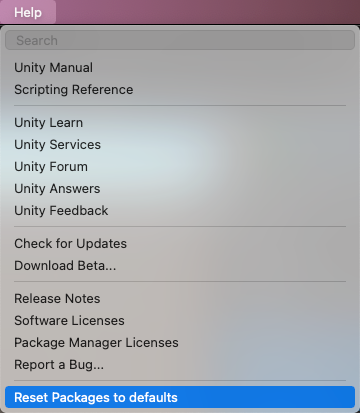
Resetting a clone of your project
Yous can besides test the return to the default packages before y'all perform the last change:
-
Clone your project by copy-pasting your projection folder and renaming it and then that it is easy to find (for example, if your project is called
MyProjectand so you could apply something likeclone_MyProject). -
Load your newly cloned project.
-
From the Help menu, select Reset Packages to defaults.
Depending on the size of your project, this might accept a few minutes.
-
Check that it successfully reset the packages. If so, you tin can perform the performance safely on the original project.
Package installation fails
If you are trying to install a new package from the registry and it is non working, it might be due to permission issues.
You must have full permissions on the enshroud binder:
- Windows:
C:\Users\yourname\AppData\Local\Unity\cache - MacOS:
~/Users/Library/Unity/cache
Information technology might be a problem with the network. Cheque your firewall and proxy settings.
Sometimes institutional environments, such as schools, government offices, or network-protected workplaces prepare proxy servers to control traffic between the network and the Internet, and use their ain server certificates which are non recognized by Unity or the Package Manager. Talk to your network ambassador.
Packages not recognized
If yous run across a lot of compilation errors, this might indicate that Unity is not recognizing the packages in your existing projection. In this instance, you lot might be missing a .Internet component.
For Windows:
- Download and install Visual Studio 2017 version xv.nine.0 or higher with the .NET Core cross-platform development workload selected under Other Toolsets.
- Download and install the .NET SDK v2.2.101 component.
For MacOS:
-
Download and install the .Net SDK v2.two.101 component.
-
Install any recommended updates in Visual Studio
-
Apply homebrew to mash and install mono:
brew update mash install mono # optional brew upgrade mono -
If necessary, delete the
Library/obj/tempfolder under your project and restart Unity. -
If you lot are still experiencing difficulties, attempt rebooting your computer equally well.
No 'git' executable was found
If you effort to install a package from a git URL, a bulletin similar to this appears:
Cannot perform upm operation: Unable to add package [https://github.instance.com/myuser/myrepository.git]: No 'git' executable was found. Please install Git on your organisation and restart Unity [NotFound] UnityEditor.EditorApplication:Internal_CallUpdateFunctions() git-lfs: command not found
If y'all are trying to download a packet that uses Git LFS (Big File Storage), yous might see this fault message:
Error when executing git command. git-lfs filter-process: command non constitute. This indicates that Git LFS is probably not installed on your car. To make sure, you could test information technology on the command line:
git lfs --version If you see something like this, Git LFS is installed:
git-lfs/2.8.0 (GitHub; darwin amd64; go 1.12.vii) Otherwise, you can install information technology by following the Bitbucket GitHub instructions.
Repository non establish
If yous specify a location that does not exist, a message like to this i appears in the Unity Console:
Cannot perform upm operation: Unable to add together bundle [https://mycompany.github.com/gitproject/com.mycompany.mypackage.git]: Mistake when executing git command. fatal: repository 'https://mycompany.github.com/gitproject/com.mycompany.mypackage.git/' not institute [NotFound] UnityEditor.EditorApplication:Internal_CallUpdateFunctions() (at /Users/builduser/buildslave/unity/build/Editor/Mono/EditorApplication.cs:310) Check your spelling. To make sure you are using the correct URL, become to the repository's page and copy the URL from the Clone button:

Click the push button to the correct of the URL on GitHub (A) or GitLab (B) to re-create the URL to your clipboard.
If the location of the repository is correct, at that place may exist another problem with the URL:
- If yous are targeting a specific revision, make sure your revision comes last. For example:
https://github.case.com/myuser/myrepository1.git#revision - If you lot are targeting a revision and the package is not at the root, brand sure the
pathquery parameter precedes the revision ballast. For instance:
https://github.case.com/myuser/myrepository.git?path=/instance/folder#v1.ii.3
Could not read Username: terminal prompts disabled
If you are trying to install a package from a individual repository that requires authentication, a message similar to this one appears in the Unity Console:
Cannot perform upm operation: Unable to add package [https://mycompany.github.com/gitproject/com.mycompany.mypackage.git]: Error when executing git control. fatal: could not read Username for 'https://mycompany.github.com': terminal prompts disabled [NotFound] UnityEditor.EditorApplication:Internal_CallUpdateFunctions() (at /Users/builduser/buildslave/unity/build/Editor/Mono/EditorApplication.cs:310) This message is likely due to the fact that Package Manager does non provide an interactive terminal or dialog where you tin can enter your username and countersign for HTTP, or your passphrase to unlock your SSH key:
-
With HTTP(S), every time you log onto BitBucket, GitHub or GitLab yous demand to enter your username and password in a terminal or a dialog box. However, the Package Manager does not provide an interactive terminal or dialog where you lot tin enter your username and password for HTTP(S).
To bypass this, utilise one of the workarounds suggested in Solutions for HTTPS.
-
SSH uses a pair of public and individual SSH keys. Yous can add your public SSH key to Bitbucket, GitHub or GitLab and and so access repositories without having to enter a username and password.
However, if y'all have set up a passphrase to keep your SSH key rubber, you withal have to enter that passphrase in a terminal or a dialog box in society to qualify your primal. In that instance, you can apply an SSH agent that can unlock your SSH central to authenticate with the Package Managing director on your behalf.
Solutions for HTTPS
The Packet Manager does not provide an interactive terminal or dialog where you can enter your HTTP(Southward) username and countersign. To bypass this, apply one of these workarounds:
- Use a credential director (Git Credential Manager for Windows or OSXKeyChain). Credential managers handle sending the countersign without having to apply a terminal or a command prompt.
- Apply git-credentials from a concluding or command prompt. So launch the Hub from the same terminal then that Unity has access to the cached or stored credentials.
- Apply SSH to authenticate instead. If you lot gear up upwardly your SSH central without a passphrase, the Package Manager doesn't have to decrypt it in guild to cosign with the Git server. If you lot decide to use a passphrase for added security, you tin can still get effectually the hallmark problem past using the ssh-agent on either macOS or Windows.
Solutions for SSH
If you are using the SSH protocol to install a package by Git URL, you lot might get an authentication error from Git. This typically happens when yous gear up a individual SSH key on your local machine that is protected by a passphrase.
The solution to this problem is to prepare an SSH agent that can unlock your SSH central to authenticate with the Packet Manager on your behalf. Follow the instructions in the department that corresponds to your operating arrangement:
- Setting up OpenSSH for Windows
- Adding SSH keys to your SSH Agent for macOS
Setting upward OpenSSH for Windows
The native Windows OpenSSH version of the ssh-amanuensis works meliorate than the version available by default with Git for Windows. This procedure explains how to set the OpenSSH client and add your key to its ssh-agent. If you are using Git for Windows, yous can too prioritize the native Windows OpenSSH over the Git for Windows SSH amanuensis:
-
Make sure the OpenSSH Client is installed by searching for it in the Windows Settings Optional features window (Start > Settings, then search for "Optional features"). This applies to Windows 10+.
-
Check your
%PATH%environment variable to brand sure the native Windows OpenSSH location appears (for case,C:\WINDOWS\System32\OpenSSH\).Annotation: If y'all are already using Git for Windows, make certain the native Windows OpenSSH location appears before the Git for Windows SSH location in your
%PATH%variable. This ensures that Windows uses the native Windows OpenSSH amanuensis over the Git for Windows SSH agent. -
In a PowerShell terminal, start the
ssh-agentprocess and make sure it starts automatically:# Ready the ssh-agent service to commencement automatically and manually start it now Get-Service ssh-agent | Set up-Service -StartupType Automatic # Run the ssh-agent process to kickoff the ssh-agent service ssh-agent -
Import your central into the ssh-agent by running
ssh-add togetheron the command line and so following the instructions. Past default, the amanuensis adds the%USERPROFILE%\.ssh\id_rsakey and prompts you for the countersign.# Import the cardinal ssh-addTo utilise a dissimilar cardinal, you can specify information technology as an statement:
# Set the ssh-agent service to start automatically and manually start it at present ssh-add <your-secure-ssh-central-name>If you can't remember the name of your key, you can ask the agent to listing them:
ssh-add -l -
If you installed Git for Windows, reset the
%GIT-SSH%environment variable to make sure that Git always uses the native Windows OpenSSH version of the ssh-agent:[Surround]::SetEnvironmentVariable("GIT_SSH", "$((Become-Command ssh).Source)", [System.EnvironmentVariableTarget]::User)
Adding SSH keys to your SSH Agent for macOS
Use the following command to add your SSH keys to the ssh-agent running on your macOS organization:
ssh-add -Grand ~/.ssh/<your-secure-ssh-central-proper noun> Afterwards you lot run this command, the terminal asks for the password to unlock your SSH key and and then adds information technology to the macOS keychain. However, once you restart your system, every cardinal stored in the ssh-agent is reset.
To prevent re-inbound your password after restarting your organization, open the ~/.ssh/config file (or create ane if you don't find it), and add the following:
Host * UseKeychain yeah AddKeysToAgent yep IdentityFile ~/.ssh/<your-secure-ssh-key-name> Restart your machine to employ these changes.
Tin can't update Git version
If you are trying to update your Git dependency The Package Director retrieves Git dependencies from a Git repository directly rather than from a package registry. Git dependencies use a Git URL reference instead of a version, and there's no guarantee near the packet quality, stability, validity, or even whether the version stated in its package.json file respects Semantic Versioning rules with regards to officially published releases of this package. More info
See in Glossary to a newer version from the repository, but it'due south non working, it's probably because your Git dependency is locked. If you want to update your Git dependency to a newer version from the repository, use the Add packet from git URL push and enter a Git URL. For more information, see Locked Git dependencies.
'Failed to parse Http response' in My Avails context
If you see the following message in the Console window when trying to download an Asset Shop parcel, there might be a problem with your Asset Shop cache:
[PackageManager] Error Failed to parse response. UnityEditor.AsyncHTTPClientone(Country, Int32)
To solve this problem, delete all downloaded assets from the Asset Store packet directory and so try downloading the assets over again.
Warning: If your project contains a lot of asset data, this might take a lot of time and bandwidth to re-download everything.
Missing 'My Registries' in the Package Manager window
Not all registry providers are compatible with Unity's Packet Manager. If the package registry server you added does not implement the /-/v1/search or /-/all endpoints, your scoped registry is not uniform with Unity's Package Director, and doesn't appear in the My Registries context in the Package Manager window.
Missing MonoBehaviour errors
While building, if there are a lot of errors about Missing Behavior, the UnityLinker might exist mistakenly stripping out a component that information technology thinks is unreferenced. It often does this because the stripping level is too ambitious. For example, if you lot have a prefab An nugget type that allows you to store a GameObject complete with components and properties. The prefab acts as a template from which you can create new object instances in the scene. More than info
See in Glossary in an AssetBundle that references the SpriteShape component in the 2D SpriteShape package, the object might be missing and might generate compiler warnings.
To set up this, you can either lower the stripping level for the UnityLinker or declare the package's assemblies inside the link.xml file in order to preserve them from being stripped:
<linker> <assembly fullname="Unity.2D.SpriteShape.Runtime" preserve="all"/> <associates fullname="Unity.second.Common.Runtime" preserve="all"/> </linker> For more information on stripping levels and the UnityLinker, see Managed lawmaking stripping.
Loading error for hostfxr.dll on Windows
If the Console reports that the hostfxr.dll library was found, but Unity failed to load it from C:\<path_to_app>\hostfxr.dll, you can set this error on Windows 7 or Windows Server 2008 R2 past installing both KB2999226 and KB2533623 patches.
Local binder or tarball paths
Source: https://docs.unity3d.com/Manual/upm-errors.html
0 Response to "Unity Saying I Uploaded Avatar but Not Showing Up on My Avatars"
Post a Comment